

The UHCW Renal Unit is the regional nephrology and transplant centre for Coventry and Warwickshire, providing specialised inpatient care for patients living in Coventry and Warwickshire, as well as inpatient support to South Warwickshire Foundation Trust Hospitals (SWFT) and George Eliot Hospital Foundation Trust (GEH).
Outpatient services are provided across the wider region with clinics at:
- University Hospital Coventry & Warwickshire
- Rugby Hospital
- Warwick Hospital
- Stratford Hospital
- George Eliot Hospital
We aim to see patients at their local hospital where possible; however, patients may be asked to travel to an alternative site for specialist care or urgent input.
More information regarding the team is available at UHCW Renal Services.
Clinical Rationale and NICE Guidance
The NICE Chronic Kidney Disease (CKD) Guidelines offer comprehensive advice regarding assessment and support primary-care management for most low-risk CKD patients.
Our referral criteria reflect NICE guidance, identifying those in greatest need of specialist care. This includes:
- Patients with intrinsic renal disease requiring specific targeted treatments.
- Patients at high risk of progressive CKD who may require renal replacement therapy (RRT).
- Early assessment for inflammatory (or autoimmune) kidney diseases.
Where feasible, we aim to review appropriate patients in an outpatient / ambulatory setting to avoid unnecessary hospital admission.
Urgent referrals can be seen in Renal Hot Clinic (twice-weekly clinics providing urgent ambulatory review).
Advice and Referral Routes
If you require advice or wish to discuss a patient to support initial management and optimal triage, please contact the renal team:
- Emergency referrals and urgent telephone advice (24/7): Contact the on-call renal team via switchboard (02476 964 000)
- 9:00 AM – 9:00 PM: Renal Registrar (Bleep 4134).
- Consultant of the Week: Available via switchboard as necessary.
- E-referrals (urgent and routine) via eReferral system. Please see Section 4-8 for helpful relevant information. Consultant-reviewed and triaged.
- Advice & Guidance (A&G): Consultant-reviewed with a 7-day response aim. If your query relates to a patient already known to the renal team, please email renal.enquiries@uhcw.nhs.uk.
CKD Referral Guide
Most referrals to the Renal Unit will be for CKD.
- A new finding of low eGFR / high creatinine requires repeating, as it could be an AKI.
- Depending on clinical context, this should be within 2 to 14 days.
- Diagnosis of CKD requires ≥2 eGFR results separated by 90 days.
- See AKI guidance for more information: Coventry & Rugby GP Gateway AKI Guidance
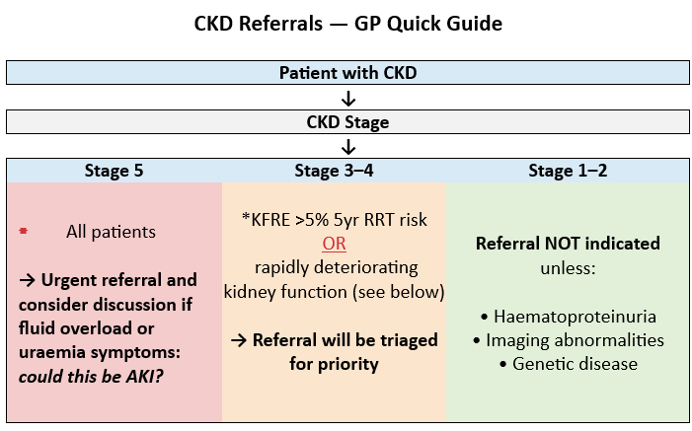
*KFRE = Kidney Failure Risk Equation, click here
High risk = 5-year risk of renal replacement therapy (RRT) >5%.
Essential Pre-Referral Requirements
- Measure Urinary ACR (uACR) for all CKD referrals.
- Calculate 5-Year KFRE Risk: Calculate the 5-year Kidney Failure Risk Equation via the KFRE Calculator. Refer if 5-year RRT risk exceeds >5%.
- Rule Out AKI: Deteriorating renal function may represent Acute Kidney Injury (AKI) rather than progressive CKD. Check for acute illness / intercurrent infection, assess fluid status, review medication, check for signs of urinary retention, perform a urine dipstick for haematuria/albuminuria, and send a uACR. Repeat U+Es urgently if the patient is unwell. Consult the Coventry & Rugby GP Gateway AKI Guidance for community pathways.
- Renal Ultrasound: If repeat renal function is not stable and progressive CKD is likely, please arrange a renal ultrasound before referral.
Stage-Specific CKD Management Criteria
New Stage 5 CKD (eGFR <15 mL/min/1.73m²): submit an urgent referral (and consider discussion particularly if fluid overload or uraemia symptoms
Stages 3–4 CKD (eGFR 15–59 mL/min/1.73m²). Refer if:
- KFRE Risk: 5-year RRT risk >5%.
- Accelerated Progression: Sustained eGFR decrease >25% (or creatinine rise >25%) within 12 months, or eGFR decrease >15 mL/min/1.73m² within 12 months.
If stable with low risk, continue primary care monitoring per NICE guidelines. Refer back if KFRE exceeds 5%, eGFR drops, progressive albuminuria occurs (uACR >70 mg/mmol, or uACR >30 mg/mmol with haematuria), or other concerns arise.
Stages 1–2 CKD (eGFR ≥60 mL/min/1.73m²): referral is generally not indicated unless accompanied by:
- Haematoproteinuria
- Structural/imaging abnormalities
- Suspected genetic disease
Discuss via A&G if specific concerns exist.
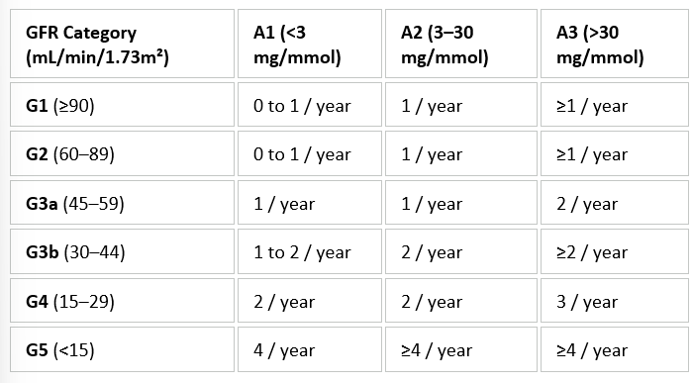
CKD/GFR Recommended Monitoring Frequencies
Monitoring frequency depends on eGFR category and ACR status, guided by NICE recommendations:
Proteinuria (& Glomerular Disease) Referral Guide
Patients with proteinuria carry a high risk of progressive disease or intrinsic renal disorders (e.g. glomerulonephritis or vasculitis); prompt referral optimises therapy and enables timely specialist investigation. Significant proteinuria is the hallmark of glomerular disease.
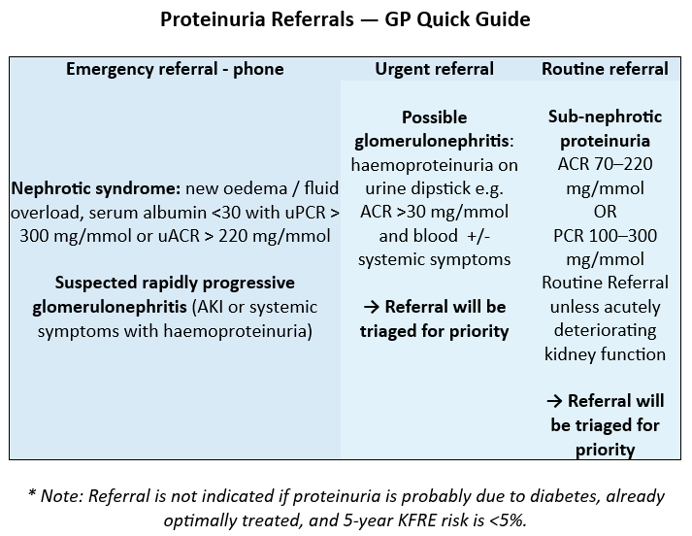
Emergency Referral / same day discussion: For suspected nephrotic syndrome or rapidly progressive glomerulonephritis, call the Renal Registrar (Bleep 4134) or On-Call Consultant via UHCW Switchboard (02476 964 000).
‘3 actions in 3 months’ (including SGLT-2 inhibitors) in proteinuric CKD
SGLT2 inhibitors are recommended for CKD with eGFR 25–60 mL/min/1.73m² and uACR >25 mg/mmol. For non-referred or co-managed proteinuric CKD, aim to complete these interventions within 3 months:
- Maximise ACEi/ARB: Initiate and titrate to the maximum tolerated dose (e.g. Ramipril 10 mg OD or Losartan 100 mg OD).
- Add SGLT2i: Initiate Dapagliflozin or Empagliflozin in accordance with clinical guidance.
- Control Blood Pressure: Target BP ≤130/80 mmHg using additional agents as required.
Note. Most of these patients will have diabetes (Type 1 or 2). If they do not (or have had it for less than 5 years), please discuss with us via A&G, and we will see soon.
See linked algorithm for more information here
Other Specific Indications for Referral
Systemic Disease: Suspected renal involvement in systemic illness (e.g. Vasculitis, SLE, Myeloma) warrants urgent referral/discussion.
Acute Kidney Injury (AKI): Should be assessed in primary care in first instance unless AKI 3. Follow link for GP Gateway AKI page
Haematuria: Depends on patient age and presentation
- Visible (macroscopic) haematuria to Urology (2-Week Wait) as per local guidelines. Urology 2WW – GP Gateway. If urological workup is negative, consider a renal referral
- Non-visible haematuria (1+ or more of blood on urine dipstick) with dysuria. Refer to Urology as per local guidelines.
- Non-visible (microscopic) haematuria (2 out of 3 positive dipstick tests) + Proteinuria (uACR >30 mg/mmol): See referral criteria in section 6.
Hypertension: Refer to UHCW Hypertension Clinic unless specific renal referral criteria are met.
Renal anaemia: E.g. Hb <100g/L with other causes excluded and eGFR <30 (or <45 if diabetes).
Rare/Genetic Conditions: Known or suspected polycystic kidney disease (PKD), Alport syndrome etc.
Renal artery stenosis.
Primary Exclusions (Do Not Refer to Renal)
- Renal masses, angiomyolipoma and simple renal cysts: Refer to Urology.
- Essential Hypertension: Cases without renal impairment or proteinuria meeting renal criteria should go to the UHCW Hypertension Clinic.
Specialist clinics
We have specialist clinics in these areas, which GPs are welcome to refer to. Please refer in the normal way via eRS, but make clear on the letter the clinic you are trying to refer to – it should be picked up when the referral is triaged:
- Polycystic kidney disease
- Renal stone disease
- Cardiorenal syndrome
- Renal-diabetic (Rugby)
- Vasculitis (with rheumatology)
- Renal-obstetric
UHCW Contact Information
We have a base Haemodialysis Unit at UHCW (tel. no. 02476 967777) and 5 satellite units at:
- Rugby (tel. no. 01788 663236)
- George Eliot (tel. no. 02476 865692)
- Whitnash, Leamington (tel. no. 01926 470309)
- Stratford (tel. no. 01789 265520)
- Clay Lane, Coventry (02476 964592)
The Peritoneal Dialysis Unit (tel. no. 02476 968285).
The Transplant Team (recipient tel. no. 02476 967744 / donor 02476 967750)
Renal Nurse Specialists
The Renal Nurse Specialists cover all aspects of pre-dialysis education, and are the patient’s primary point of contact – and responsible for liaison with primary care. Other responsibilities include: being the point of contact for EPO (erythropoietin), monitoring efficacy, dose adjustments and organising repeat prescriptions; and follow-up of conservative management patients including End-of-Life care. Contact the RNS Team (tel no. 02476 9677786).
Renal Dietetics
If you have any nutritional concerns or diet related queries for a CKD patient please refer to the renal dietetic team at UHCW (tel. no. 02476 966151)
Healthy Eating with CKD Advice:
Healthy Eating for Patients with CKD (National Kidney Federation)
Renal Clinical Psychology Service
The Renal Unit offers Clinical Psychology support to any patient or relative (known to the team) affected by the emotional and psychological impact of living with kidney disease. Please ask for referral through their consultant.
Ward Base
Renal Ward W50 (tel 02476 96 8257 / 8259)
Transplant Ward W10 (tel 02476 96 5635 / 5633 / 5770)
 For review soon
 Awaiting review
 Invalid notification
 Coventry
 Rugby & South Warwickshire
 North Warwickshire
 South Warwickshire
Leave feedback
You must be logged in to post a comment.